



A Press of Canvas
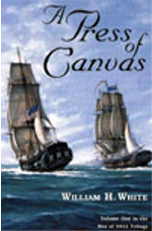 Isaac Biggs of Marblehead, Massachusetts, sails from Boston as captain of the foretop aboard the
bark Anne, bound for St. Barts in the West Indies in the fall of 1810. When the Anne is stopped by
a British Royal Navy frigate, Isaac and several shipmates are forcibly pressed into service aboard
HMS Orpheus, actively engaged in England's long-running war with France.
Isaac Biggs of Marblehead, Massachusetts, sails from Boston as captain of the foretop aboard the
bark Anne, bound for St. Barts in the West Indies in the fall of 1810. When the Anne is stopped by
a British Royal Navy frigate, Isaac and several shipmates are forcibly pressed into service aboard
HMS Orpheus, actively engaged in England's long-running war with France.
The young Isaac faces the harsh life of a Royal Navy seaman and a harrowing war at sea. His new life is hard, with strange rules, floggings, and new dangers. Then the United States declares war on England and Isaac finds himself in an untenable position, facing the possibility of fighting his own countrymen.
BUY NOW in Paperback or Kindle Edition



Reviews
“The Age of Fighting Sail has been well portrayed by C.S. Forester, Patrick O'Brian and their followers.
But all of these writers saw the world from the quarterdeck. Now comes William H. White with
A Press of Canvas
to present the same conflicts on the same ships from the viewpoint of a fo’c’sle hand. It is a worthy
effort, well executed, and thoroughly engaging, and all of us who love the subject matter are in his debt.”
Donald Petrie
Author: “The Prize Game, Lawful Looting on the High Seas in the Days of Fighting Sail”
Naval Insititute Press 1999
“A great read... a very engaging story with believable, honest characters... taught me a lot about this period of history... just fabulous!”
John Woolridge, Managing Editor
Motorboating and Sailing
“The book disappears - you find yourself right there watching the action unfold.”
Fine Tops’l Breeze
 Isaac Biggs ships as Third Mate on the Salem privateer General Washington in February 1813. At the
same time, his friends from the British frigate Orpheus and the Baltimore schooner Glory find berths
on the American warship USS Constellation and, eventually, they wind up on the USS Chesapeake in
Boston just in time for her disastrous meeting with HMS Shannon. Throughout the spring of 1813,
Isaac and the General Washington roam the waters between Massachusetts and Nova Scotia, taking prizes
and harassing the British. When the American survivors of the Chesapeake / Shannon battle are confined
in Melville Island Prison in Halifax, the General Washington and Isaac play an important role
in securing their freedom.
Isaac Biggs ships as Third Mate on the Salem privateer General Washington in February 1813. At the
same time, his friends from the British frigate Orpheus and the Baltimore schooner Glory find berths
on the American warship USS Constellation and, eventually, they wind up on the USS Chesapeake in
Boston just in time for her disastrous meeting with HMS Shannon. Throughout the spring of 1813,
Isaac and the General Washington roam the waters between Massachusetts and Nova Scotia, taking prizes
and harassing the British. When the American survivors of the Chesapeake / Shannon battle are confined
in Melville Island Prison in Halifax, the General Washington and Isaac play an important role
in securing their freedom.
BUY NOW in Paperback or Kindle Edition
Reviews
“By the publication of A Fine Tops’l Breeze,
the second in his War of 1812 Trilogy, William H. White had taken his place in the charmed
circle of writers of really good fiction about the days of fighting sail: Melville, Forester,
O'Brian, Nelson, and Kent. Like them, his attention to the detail of ships and their hulls,
spars, and rigging and sails is meticulous. And, like them, his characters are not only credible,
but memorable. He is a thoroughly welcome writer to this genre, which has brought so much pleasure to so many.”
Donald Petrie
Author: “The Prize Game, Lawful Looting on the High Seas in the Days of Fighting Sail”
Naval Insititute Press 1999
“Once again, I found myself participating in the action - living it more than seeing it. It was incredibly thrilling.”
“Through Bill White’s evocative prose, one smells the salt breeze and feels the pulse of life at sea during the War of 1812.”
John B. Hattendorf
Ernest J. King Professor of Maritime History, U.S. Naval War College
“The action in White’s second book is outstanding! You can almost feel the heat of the guns and the cold spray sting your face as you follow Isaac through his next adventures.”
“Sailors everywhere will rejoice in the salt spray, slanting decks and high adventure of this lively yarn of the young American republic battling for its rights at sea.”
Peter Stanford, President
National Maritime Historical Society
The Evening Gun
 With the Atlantic seaboard closed by the blockade, the action shifts to Joshua Barney's gunboats
where Isaac and Jack Clements find themselves commanding sloop rigged raiders assisting the effort
in Maryland. They witness the British landing at Benedict MD and the burning of our capital.
Sent to Baltimore to assist with the preparations for the expected British invasion, they witness
the bombardment of that city and the writing of the Star Spangled Banner.
With the Atlantic seaboard closed by the blockade, the action shifts to Joshua Barney's gunboats
where Isaac and Jack Clements find themselves commanding sloop rigged raiders assisting the effort
in Maryland. They witness the British landing at Benedict MD and the burning of our capital.
Sent to Baltimore to assist with the preparations for the expected British invasion, they witness
the bombardment of that city and the writing of the Star Spangled Banner.
BUY NOW in Paperback or Kindle Edition
Reviews
“...Read the trials and tribulations of Isaac Biggs and enjoyed them immensely.
Haven't read anything like this since Forester. You write better sea stories than I do.”
Clive Cussler
Author of the Dirk Pitt Series
On the WAR OF 1812 TRILOGY
“A great read... a very engaging story with believable, honest characters... taught me a lot about this period of history... just fabulous!”
John Woolridge, Managing Editor
Motorboating and Sailing
“The War of 1812 truly is the forgotten war. Few Americans recall much except there were some naval engagements and we won the Battle of New Orleans. Many don't realize that Washington D.C. was burned, let alone know about the battles on the Patuxent. The reason for this, I believe, is that there are few novels or films about the war, as compared to the American Revolution and the Civil War. Bill White has tried to rectify this and has brought this neglected period of our history alive. THE EVENING GUN concludes his War of 1812 Trilogy, with all the drama, panic and confusion that gripped Washington, D.C., Baltimore and the Chesapeake region as a whole in 1814. Seen from the viewpoint of the ordinary sailors, the war was not glamorous and all pitched battles. The description of the attack on Baltimore and the writing of the "Star Spangled Banner" humanize an event that we don't think about, when we sing our National Anthem. The War of 1812 and the sacrifices that were made to preserve our liberty will be better understood, after reading THE EVENING GUN. An enjoyable way to learn history.”
Doug Alves
Director, Calvert Marine Museum
Solomons, MD
The Greater the Honor
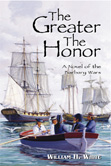 In this historically accurate, colorful, and carefully crafted tale, 14 year-old midshipman Oliver
Baldwin tells the story of our fight with the corsairs of the Barbary Coast from the deck of Captain
Stephen Decatur’s ship as the young man, like the young nation he represents, struggles to find
his way on the course to manhood. Gunboat battles, duels, and storms encourage his personal growth
and challenge his maturity as he learns his role as an officer-in-training of the United States Navy.
More than a “sea story,” it is a coming of age story of both a young man and the
fledgling navy he serves.
In this historically accurate, colorful, and carefully crafted tale, 14 year-old midshipman Oliver
Baldwin tells the story of our fight with the corsairs of the Barbary Coast from the deck of Captain
Stephen Decatur’s ship as the young man, like the young nation he represents, struggles to find
his way on the course to manhood. Gunboat battles, duels, and storms encourage his personal growth
and challenge his maturity as he learns his role as an officer-in-training of the United States Navy.
More than a “sea story,” it is a coming of age story of both a young man and the
fledgling navy he serves.
BUY NOW in Hardcover, Paperback or Kindle Edition
Reviews
“White’s fourth book is his best effort to date. The novel is a ‘coming of age story’
about a young sailor named Oliver Baldwin who signs on as a midshipman in the US Navy during the early 1800’s.
Historically accurate, the novel’s main focus surrounds the Barbary Wars where the fledgling country,
The United States of America, is defending its merchants from Mediterranean pirates.”
“Unique to this novel is the way that White introduces young Baldwin to the trials and tribulations of life as a sailor. The various parts and names of 18th century sailing ships can cause the novice to this period shy away from these types of stories. White does an excellent job teaching the reader as Baldwin learns and grows accustomed to life aboard a naval ship.”
“I frequently found myself fully engrossed in the story, looking over Baldwin’s shoulder as he works aboard the ship, makes friends with his fellow shipmates, and fights the pirates of the Mediterranean. The novel is fast paced, and the descriptions are truly magnificent. From the sea spray in your face, to the boom of the guns, to the heat of the battle, White truly puts you in the front row seat for all the action.”
“White’s skill as a novelist and his passion for historical accuracy put him on a course with Patrick O’Brian.”
William Fowler, Ph.D.
Dir. Massachusetts Historical Society
“The book disappears - you find yourself right there watching the action unfold.”
In Pursuit of Glory
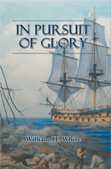 Following his return from the Barbary Coast, Oliver Baldwin is assigned in USS Chesapeake
just in time for her epic and disastrous meeting with HMS Leopard outside the Virginia Capes.
He testifies at Commodore James Barron’s court martial in 1808 and then sails, again under
Captain Steven Decatur in Chesapeake, to enforce the Jeffersonian Embargo. Reassigned, with
Decatur to the heavy frigate United States, Baldwin experiences the start of the War of 1812
and the capture of HMS Macedonian, one of the most thrilling single-ship engagements of the war.
Following his return from the Barbary Coast, Oliver Baldwin is assigned in USS Chesapeake
just in time for her epic and disastrous meeting with HMS Leopard outside the Virginia Capes.
He testifies at Commodore James Barron’s court martial in 1808 and then sails, again under
Captain Steven Decatur in Chesapeake, to enforce the Jeffersonian Embargo. Reassigned, with
Decatur to the heavy frigate United States, Baldwin experiences the start of the War of 1812
and the capture of HMS Macedonian, one of the most thrilling single-ship engagements of the war.
BUY NOW in Hardcover, Paperback or Kindle Edition
Reviews
“White cleverly recreates the language and manners of days long past while sticking closely to
the basic historical facts. He weaves his fictional and historic personages seamlessly into the
context of the times and brings to life a time when the U.S. Navy was emerging from infancy to adolescence.”
William Dudley Ph.D.
Chairman emeritus Navy Historical Foundation
“If you yearn to smell the salt air, hear the wind sing through the rigging, and feel the roll of the sea beneath your feet, but you don't have a ship of your own, step aboard In Pursuit of Glory. If you want to duck British cannonballs and ride out storms at sea, all from the safety of your favorite armchair, set sail with William White. If you do, he'll take you on a fascinating voyage into American naval history, and you'll make port edified and entertained.”
William Martin
NY Times bestselling author of Cape Cod, Annapolis, Citizen Washington, Back Bay, Harvard Yard
When Fortune Frowns
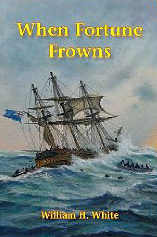 Most people are aware of the story of the Mutiny on the Bounty. Few, however, know what happened to
the mutineers. They did not all sail to Pitcairn Island; indeed only nine of them did, leaving sixteen
in Tahiti by their own choice. The Royal Navy was not about to let them remain at large and sent an
armed frigate, HMS Pandora, to the Pacific to capture them and return them to England for trial.
When Fortune Frowns is the story of this voyage, the capture of the remaining mutineers, and the
perilous and disastrous return voyage to England. Storms, tropical islands, monotony, and shipwreck
all figured into the epic tale, unearthed and carefully researched by noted maritime author
William H. White. A well crafted conclusion to one of the most heinous and well known stories of the Age of Sail.
Most people are aware of the story of the Mutiny on the Bounty. Few, however, know what happened to
the mutineers. They did not all sail to Pitcairn Island; indeed only nine of them did, leaving sixteen
in Tahiti by their own choice. The Royal Navy was not about to let them remain at large and sent an
armed frigate, HMS Pandora, to the Pacific to capture them and return them to England for trial.
When Fortune Frowns is the story of this voyage, the capture of the remaining mutineers, and the
perilous and disastrous return voyage to England. Storms, tropical islands, monotony, and shipwreck
all figured into the epic tale, unearthed and carefully researched by noted maritime author
William H. White. A well crafted conclusion to one of the most heinous and well known stories of the Age of Sail.
BUY NOW in Hardcover, Paperback or Kindle Edition
Reviews
“William White brings to life the maritime history of HBM frigate Pandora’s quest for
HMAV Bounty and her mutinous crew. This riveting novel is a scholarly, well-written tale with wonderful
descriptions of the banality of 18th century British naval life, punctuated by brutality and occasional
bravado, but always liberally flavored with the salty language of the time.”
Louis Arthur Norton, PhD
Maritime historian and author
“When Fortune Frowns is great historical fiction - a fascinating (and true) story, scrupulously researched and fleshed out with characters who have the ring of authenticity. William H. White has done a fine job of bringing the story of the Pandora, the often forgotten sequel to the mutiny on the Bounty, to life.”
James L. Nelson
George Washington’s Secret Navy
Weaving fact with fiction has produced a wonderfully engaging yarn of the sea and the era of wooden sailing vessels.
It is autumn 1790 when Captain Edward Edwards takes command of HMS Pandora, a 24-gun Royal Navy Porcupine-class frigate bound for the South Seas. Her mission: locate and capture the mutineers who seized His Majesty’s Armed Vessel Bounty, and set Captain William Bligh and eighteen loyal officers and seamen adrift, and recover the lost vessel.
In When Fortune Frowns, William H. White skillfully tells the story of HMS Pandora through the eyes of Lieutenant Edward Ballantyne, a fictional character, who joins the ship’s company under Captain Edwards in Portsmouth Harbour as she is about to sail. Ballantyne’s English dialect voice adds an authenticity to his narrative, which White says came “from spending a great deal of time with British people in Cayman - learning phrasing and expressions that they used, and that an American would likely not.”
Although technically a novel, When Fortune Frowns sticks to documented facts concerning Pandora, Captain Edwards, and the actual historical figures who took part in the Bounty mutiny and the ensuing events over a period of five years. Early on, as Ballantyne strolls through the Georgian-period Royal Dockyard in Portsmouth in search of Pandora, the aroma of Stockholm tar and canvas wafts off the pages. “It’s all coming back,” the young lieutenant says to himself. “... the smells, the language, the hustle and bustle of a busy yard. Like coming home again!”
And indeed it is for readers of the sea. The Royal Dockyard scene had been written prior to his visit there to read Pandora’s original log in the Naval Archives. “After I walked through those huge wooden gates and toured the yard,” White recalls, “I realized I had to rewrite the whole scene to ‘get it right.’”
George Jepson
Quarterdeck Magazine
McBooks Press
“...our flag was still there”
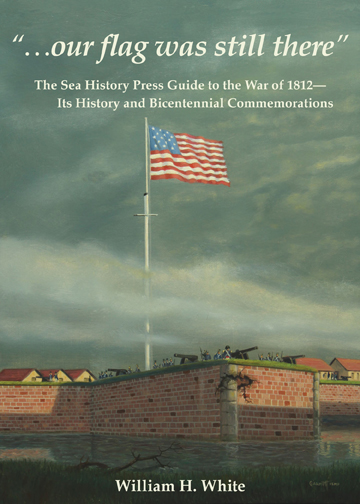 Most of us know the words – or some of them – to the Star Spangled Banner, our National Anthem, but
do you know why it was written and when? What do you know about the War of 1812? This war was a
defining time in American history – one that established who we would become and gave us entry
to the world stage as a nation to be reckoned with.
Most of us know the words – or some of them – to the Star Spangled Banner, our National Anthem, but
do you know why it was written and when? What do you know about the War of 1812? This war was a
defining time in American history – one that established who we would become and gave us entry
to the world stage as a nation to be reckoned with.
As we approach the bicentennial of the War of 1812, White’s new book will fill the gaps in the public’s understanding of this important but understudied conflict – the events leading up to the declaration of war in June 1812, the major battles on land and sea, the conclusion, and the key players. It will answer the questions “What happened?” “Who won?” and “Why does it matter?”
The Bicentennial will be celebrated in key port cities from New Orleans to Boston and on the Great Lakes. Cities and towns across the country will host celebrations, including airshows and parades, fireworks and concerts. Port cities will host the magnificent sailing ships of Operation Sail as well Navy ships, both American and foreign in a three year spectacle of celebration and commemoration.
Available January, 2012 but you can pre-order now at
The National Maritime Historical Society Ship's Store.
Reviews
“There are many books available today purporting to be about the War of 1812;
“. . . our flag was still there” is the one to buy, read and keep.
Not only does Mr. White give a concise and accurate description of the major battles, but he discusses
the political situation leading up to the war, the causes, and the outcome. A brief discussion of
the disastrous financial situation of our government appears in the conclusion. Perhaps best of all
is a listing of the bicentennial celebrations planned for this important historical event that
shaped the course of America for the future. A worthy read, and illuminating.”
George Murchison,
RADM, USN (ret)

